
Top brands in Harnesses



Showing all 16 resultsSorted by latest


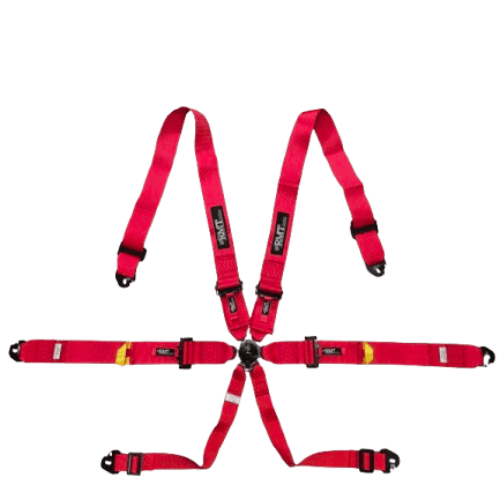
RMT Racing 6 Point 3×3 inch FIA Safety Harness

RMT Racing 6 Point Harness


Harnesses guide
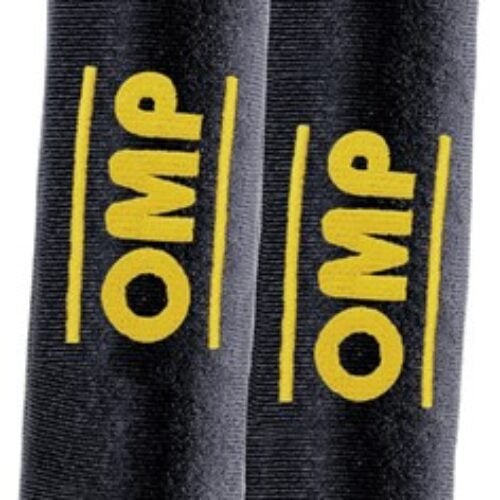
A harness holds the occupant in the seat, so that in a crash the body slows down with the car instead of moving on until something stops it. The range covers 4-, 5- and 6-point harnesses, including 6-point sets homologated to FIA 8853-2016, with harness pads and a belt cutter.
The lap belt anchors the body through the pelvis, the strongest part of the skeleton a belt can bear on. It must sit low and tight across the hip bones, never over the abdomen.
Shoulder straps stop the torso pitching forward. Crotch straps hold the lap belt down: without them the body can slide underneath it, which is called submarining. A 5-point harness has one crotch strap, a 6-point harness two.
Geometry decides how well a harness works:
- Shoulder strap angle: the straps should run back from the shoulders level or slightly downwards. Competition rules cap how steeply the shoulder straps may run down from the seat back and recommend a flatter line, as steep straps compress the spine in a frontal impact.
- Strap spacing: the same rules limit how far the shoulder straps may converge or diverge from the seat’s centre line, seen from above. Take the exact angles from your series’ current regulations.
- Lap belt path: lap straps pass through the seat’s slots, not over its sides, so they wrap the pelvis over a wide area.
- Webbing width: a 2×3 inch harness pairs 3-inch lap belts with 2-inch shoulder straps, which are made for use with a frontal head restraint only. A 3×3 inch harness uses 3-inch webbing throughout.
- Homologation: an FIA 8853-2016 harness carries an FIA hologram on its label, and its validity is limited, so check the label against your series rules each season. Harnesses without that label suit uses where none is required.
- Extras: pads in 2-inch and 3-inch widths ease pressure on the collarbones, and a belt cutter frees a trapped occupant.
The 6-point sets come without eyebolts, so plan the anchorages first and check them against your series’ current regulations. Use strong points on the floor or cage, with backing plates, as close to the ideal angles as the car allows. Never twist the webbing or let it run over sharp edges. Tighten the lap belt first, then the shoulder straps.
Replace the harness after a heavy impact, since the polyester webbing stretches to absorb it and does not fully recover. Replace it too when the webbing is cut, frayed or faded.

Store Information
TrackTool Factory
Sluispolderweg 7A
1505 HJ Zaandam
The Netherlands
Chamber of Commerce (KVK): 97296902
VAT: NL867990375B01