

Top brands in Lambda / O2 Sensor Bungs



Showing all 18 resultsSorted by latest



Lambda / O2 Sensor Bungs guide
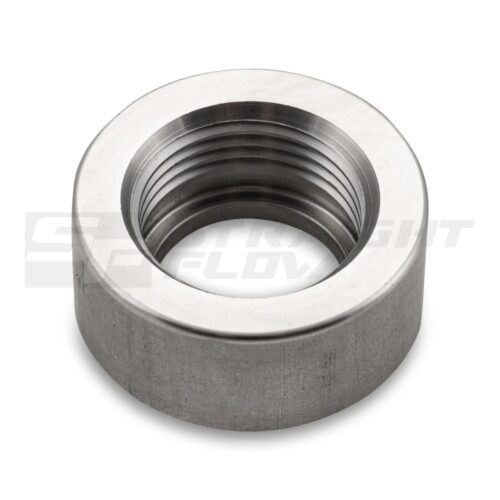
A lambda sensor bung is a threaded boss welded into the exhaust so that an oxygen sensor can read the gas. Weld-in bungs for lambda, exhaust temperature and NOx sensors are listed here, plus lambda adapters and spacers in straight, 45° and 90° forms.
Position decides how well a sensor works. It should see gas from every cylinder, so it belongs after the collector or turbine, and a fuelling sensor goes ahead of the catalyst. Too close to the port and it runs too hot; too far back and it is slow to warm up and respond. An air leak upstream gives a false lean reading, which the engine management answers by adding fuel the engine does not need.
Mount the boss in the upper half of the pipe, tilted so that the sensor tip points downwards. Condensate then drains away from the element instead of pooling on it, where it can crack a hot sensor.
Match the thread and the angle:
- Thread: M18 × 1.5 for lambda sensors, M12 × 1.25 for temperature sensors and M20 × 1.5 for NOx sensors.
- Shape: straight bungs, and 45° bungs that angle the sensor in a tight space. Sizes are listed by outside diameter and length, such as D25 L20–30 for a 45° bung.
- Adapters: straight, 45° and 90° lambda adapters, listed for Euro 4, Euro 5 or Euro 6 cars.
- Spacers: straight and 90° spacers move the sensor tip partly out of the gas stream, which changes its reading. They are sold for the rear sensor behind a replacement catalyst or header.
Drill the hole to suit the bung, then weld it with an old sensor or a plug screwed in, so spatter and distortion cannot spoil the thread. Fit sensors with an anti-seize made for oxygen sensors, kept off the tip, and tighten them to the sensor maker’s figure.
On a road car, a spacer or adapter must never be used to hide a missing or failed catalyst. A sensor that reads lean at idle after exhaust work usually points to an air leak at the bung or at a joint upstream.

Store Information
TrackTool Factory
Sluispolderweg 7A
1505 HJ Zaandam
The Netherlands
KvK 97296902
BTW NL867990375B01
