Top brands in Tie Bars

Popular cars in Tie Bars
Tie Bars guide
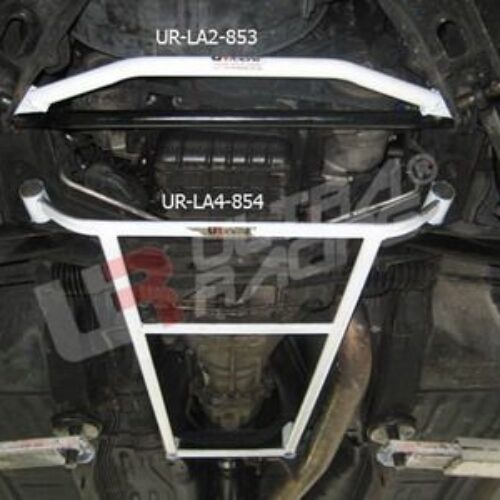
A tie bar is the simplest chassis brace: a straight bar bolted between two points to stop them moving closer together or further apart. The tie bar listed here is a two-point front lower bar that links the left and right sides of the front underbody.
Cornering pushes the loaded wheel’s lower arm sideways, and its mount tries to move relative to the one opposite. A bar between them works in tension and compression, so each side borrows stiffness from the other. That keeps the arm pivots, and with them camber and toe, closer to where the alignment set them.
A two-point bar resists only a change in the distance between its ends. It does little against both mounts sliding sideways together, which is where three- and four-point braces in the lower braces section come in. In return, a tie bar is light, quick to fit and easy to inspect.
Before choosing, check:
- Vehicle: the title gives the model, chassis code and years, and bolt spacing varies between chassis.
- Scope: a front lower bar works on steering precision; for stiffness in more directions, compare multi-point braces for the same car.
- Clearance: the bar sits low under the engine bay, so check the gap to the sump, exhaust and road on a lowered car.
Tie bars normally bolt to existing threaded points. Torque the bolts to the vehicle maker’s figure and recheck them after the first few drives, as paint under the brackets can bed down. After grounding, sight along the bar for bends; a bent bar preloads the mounts and should be replaced rather than straightened.

Store Information
TrackTool Factory
Sluispolderweg 7A
1505 HJ Zaandam
The Netherlands
Chamber of Commerce (KVK): 97296902
VAT: NL867990375B01