
Fuel System
AN Weld-On Fittings & Bungs
- 96 products
- 3 brands
- Ships from EU stock
- AN Weld-On Fittings & Bungs guide
Top brands in AN Weld-On Fittings & Bungs



Showing 1–48 of 96 resultsSorted by latest



AN Weld-On Fittings & Bungs guide
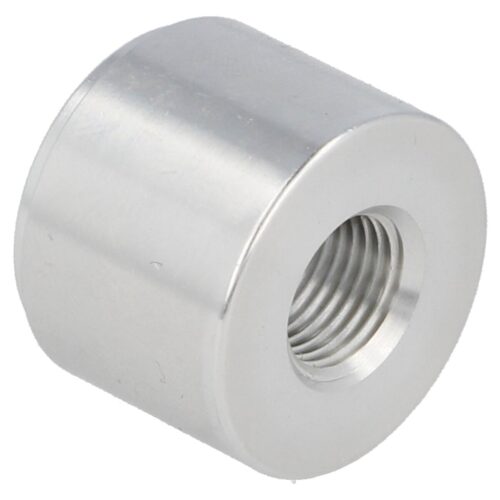
Weld-on fittings, also called bungs, are threaded bosses welded into a tank, sump, catch can, intake pipe or exhaust to give it a proper port. The range covers male AN bungs, female O-ring bungs, NPT bungs, metric weld nuts including one for a lambda sensor, weld plugs and aluminium filler necks, in aluminium or steel.
The port type decides how every later connection seals. A male AN bung carries its own 37° cone, so a hose end screws straight on. A female O-ring bung takes a straight-thread fitting sealed by an O-ring, so the hose end, angle or size can change later without touching the weld. NPT bungs seal on a taper with sealant and suit plugs, sensors and drains.
Welding heat is the main risk to the fitting itself. It can pull a thread out of round, warp the sealing face of an O-ring bung, or leave spatter inside the part. Protect the thread with a spare plug, weld in short runs on alternate sides to limit distortion, and chase the thread once the part has cooled.
Choose the port, then the material:
- AN threads: male bungs and weld nipples for direct hose connections, and AN-threaded weld nuts, across AN3 to AN20.
- Female O-ring: bungs in -6, -8, -10, -12 and -20, the flexible choice where the plumbing may change.
- NPT: bungs and weld plugs from 1/8 to 1 NPT, for sensors, drains and pipe-thread adapters.
- Metric: weld nuts in M10×1.0, M12×1.5, M14×1.5, M16×1.5, M18×1.5 and M20×1.5; the M18×1.5 lambda nut takes a standard oxygen sensor.
- Material: aluminium or steel, with a few stainless steel parts. Weld like to like: aluminium bungs into aluminium, steel bungs into steel.
- Filler necks: aluminium weld necks of 32, 38 and 42 mm for radiators and tanks, and a spare O-ring for a 50 mm neck and its cap.
Never weld a tank, pipe or can that has held fuel until it has been cleaned and purged, as trapped vapour can explode. Fit a lambda bung where the exhaust from the cylinders it reads has merged, on the upper half of the pipe, so condensation drains away from the sensor tip. Put drain bungs at the lowest point and pickups where the fluid sits under load.
After welding, check that an O-ring face is flat and clean out spatter and swarf. Pressure test a tank or sump with low air pressure and soapy water before it goes on the car, and check the welds again after the first heat cycles.

Store Information
TrackTool Factory
Sluispolderweg 7A
1505 HJ Zaandam
The Netherlands
KvK 97296902
BTW NL867990375B01
