Top brands in AN Banjo Fittings


Showing 1–48 of 54 resultsSorted by latest




AN Banjo Fittings guide
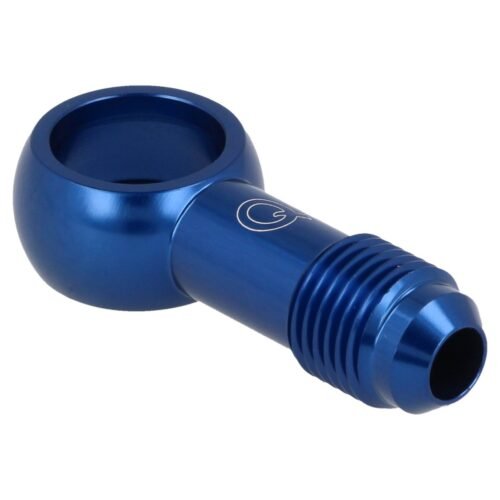
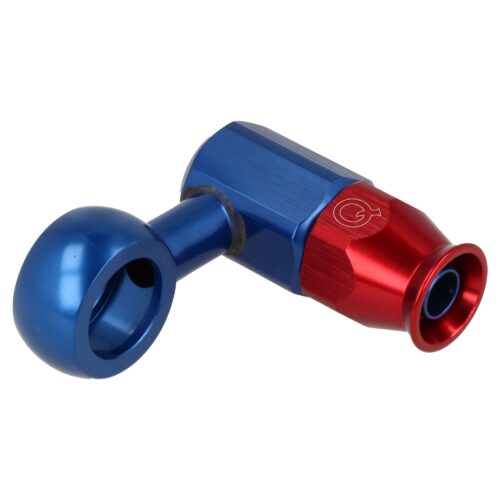
AN banjo fittings connect a hose to a component through a ring-shaped eye clamped by a hollow banjo bolt, rather than a fitting screwed into the port. The joint is compact and can leave the component at any angle, which is why banjos are common on fuel pumps, filters, carburettors and many brake and oil connections. Here they come as aluminium and stainless steel eyes with AN connections, plus carburettor inlet adapters.
Inside the joint, fluid passes through cross-drillings in the bolt into a groove machined around the inside of the eye, then out along the hose. A sealing washer on each face of the eye makes the seal, squeezed between the bolt head, the eye and the component. Because the flow must pass those small holes, a banjo restricts more than a direct port of the same hose size, which matters on a high-flow fuel feed.
Three details define the right eye:
- Eye bore: listed in millimetres, from 10.2 and 10.5 mm up to 22.2 mm, with 11, 11.2, 12.5, 14.5, 16.5 and 18.5 mm between. The bore must match the bolt shank with only a small clearance, so measure the bolt or its thread first.
- Hose size: AN3 to AN12, from 3/8-24 UNF to 1 1/16-12 UNF. A large hose on a small eye gains little, because the bolt sets the restriction.
- Angle: stainless steel AN3 and AN4 eyes come straight or at 20°, 45° or 90°, some with a male AN thread to take a hose end.
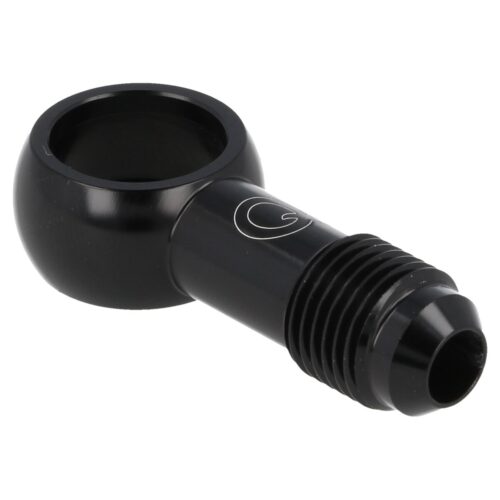
Material follows the job. Aluminium eyes, in black, blue or two-tone blue/red, suit fuel and oil lines, while stainless steel eyes suit small brake and clutch lines. The carburettor adapters come single or double with AN6 connections, for standard braided or PTFE hose.
Fit new sealing washers every time, sized to the bolt, because a crushed washer does not reseal reliably. Both faces of the eye and the port must be clean, flat and free of burrs. Set the eye’s direction, hold the hose so it cannot rotate, and tighten the bolt to the component maker’s figure, not beyond, as an aluminium eye can spread.
The bolt itself is chosen separately, by thread, length and single or double type. Leak check under pressure with the engine off, then running, and bleed any brake circuit after a banjo change. A weep usually comes from a reused washer, a marked face or a bolt pulled up out of square.

Store Information
TrackTool Factory
Sluispolderweg 7A
1505 HJ Zaandam
The Netherlands
Chamber of Commerce (KVK): 97296902
VAT: NL867990375B01