
Top brands in Turbine Housings


Showing 1–48 of 151 resultsSorted by latest


PSR Turbine Housings for PSR3584 Gen3 Turbos

PSR 62G Turbine Housings for 5862G 6262G 6862G Turbos

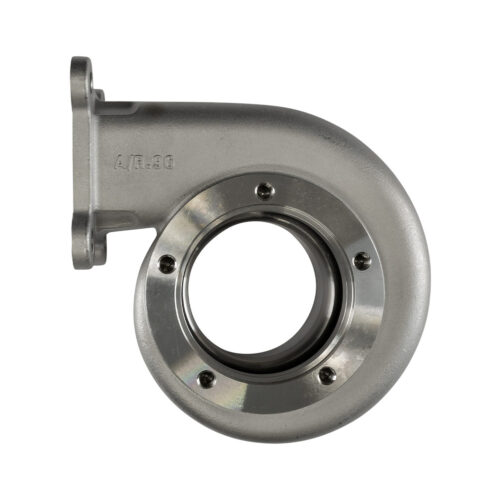
Turbine Housing B Frame (T4 0.96AR) suit 66mm Turbine
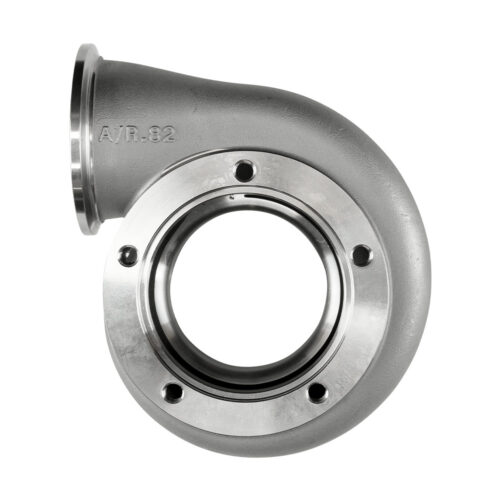


Pulsar 5-Bolt Turbine housing for Ford Falcon XR6

S300GX Turbine Housing T3 0.80A/R IWG Turbine Housing for 94-02 DODGE CUMMINS 5.9L
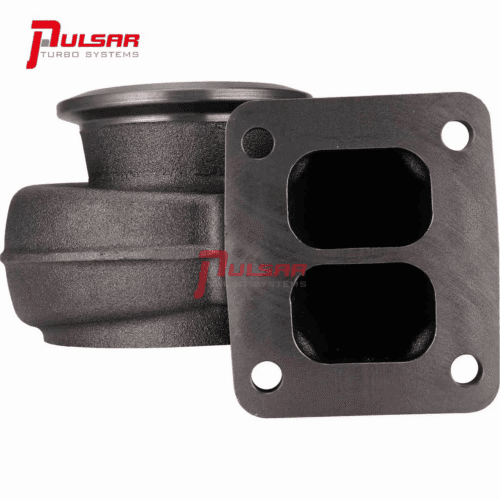
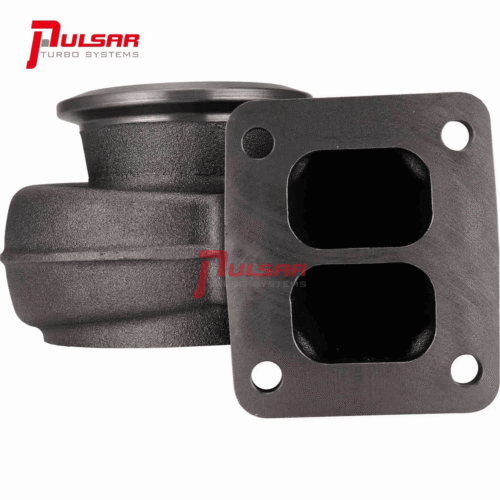


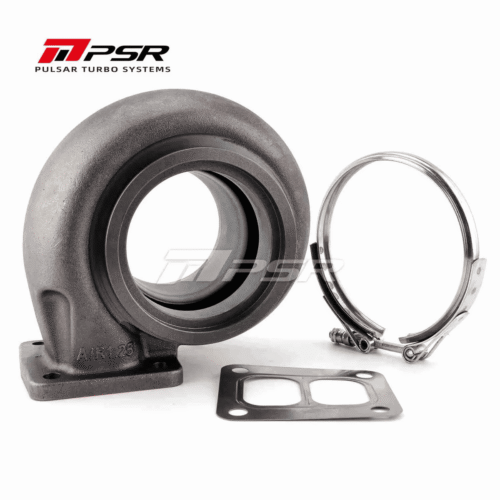


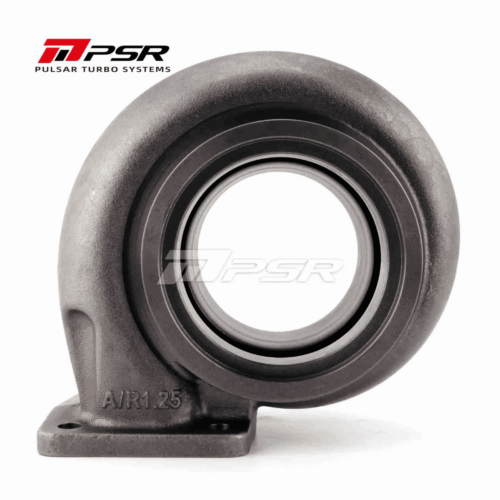
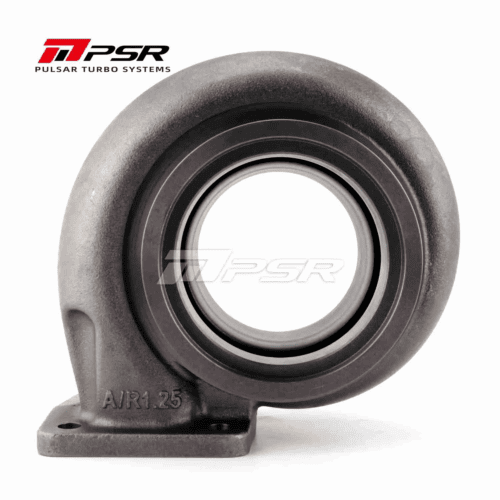
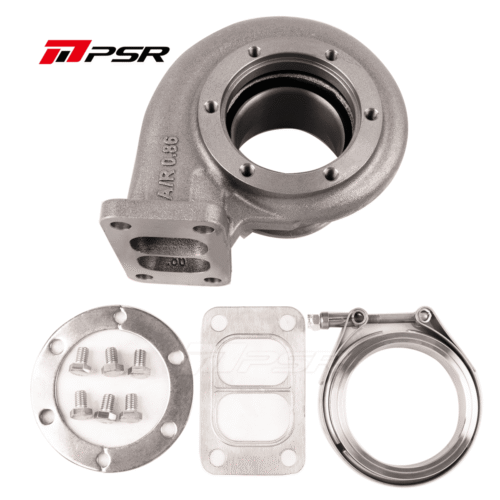
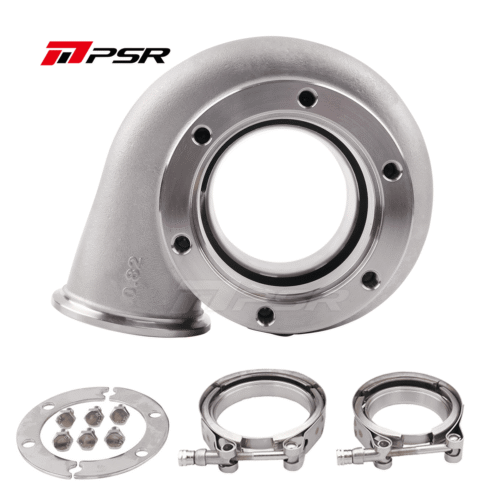
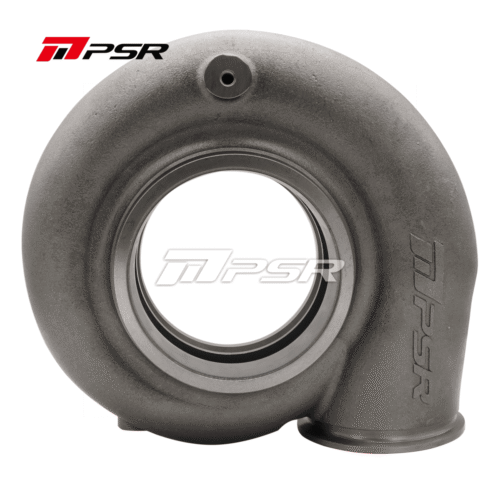
PSR PRO Turbine Housings for PRO88 PRO98 PRO106 Turbos – Dual Vband 1.09A/R
Turbine Housings guide
The turbine housing is the exhaust half of the turbocharger shell. Its spiral passage, the volute, narrows towards the turbine wheel, speeding the exhaust up and steering it onto the blades. A different housing changes how early the turbo responds, how much it flows and how it bolts to the manifold, while the centre section and wheels stay the same.
The key figure is the A/R ratio: the area of the volute’s throat divided by the distance from the wheel’s centre to the centre of that area. A small A/R speeds the gas up, so boost arrives sooner, but at high engine speed it chokes flow and drives exhaust manifold pressure up. A larger A/R lowers that back pressure and frees the top end, at the cost of later boost. When manifold pressure runs far above boost pressure, the engine pumps against its own exhaust, traps more hot gas in the cylinders and becomes more prone to knock.
Choose by turbo, wheel and exhaust layout:
- Turbo and wheel: each housing is listed for a turbo family or frame, often with its generation. Many also name one turbine wheel size, such as 83/74, 87.1/81.4, 96/88 or 101/91.3 mm, because the inner contour has to match the wheel.
- A/R: most families come in several steps, for example 0.63, 0.82 and 1.06 in T3 form, rising to 1.58 in T6 form. Smaller suits response; larger suits top-end flow and lower back pressure.
- Inlet flange: T3, T4 or T6 bolt-on flanges, open or divided, or a V-band. A divided (twin-scroll) inlet keeps the pulses of paired cylinders apart up to the wheel, which pays off with a divided manifold.
- Outlet: V-band outlets are sized for 3, 3.5 or 4″ outer diameter tubing, and dual V-band housings clamp at both ends.
- Material and rotation: some housings are stainless steel, and reverse-rotation versions suit mirrored twin-turbo layouts.
On bolted flanges, fit new gaskets and high-temperature studs or nuts with anti-seize, and tighten in steps. Clock the housing to the manifold and downpipe while keeping the centre section’s oil drain pointing down. Plan the wastegate with the housing: where it has no internal gate, an external gate on the manifold has to do the job. Check old housings for cracks around the inlet and the scroll divider, and keep the joint ahead of the turbine leak-free.

Store Information
TrackTool Factory
Sluispolderweg 7A
1505 HJ Zaandam
The Netherlands
KvK 97296902
BTW NL867990375B01
