
Brake System
Brake Nipples & Fittings
- 85 products
- 2 brands
- Ships from EU stock
- Brake Nipples & Fittings guide
Top brands in Brake Nipples & Fittings




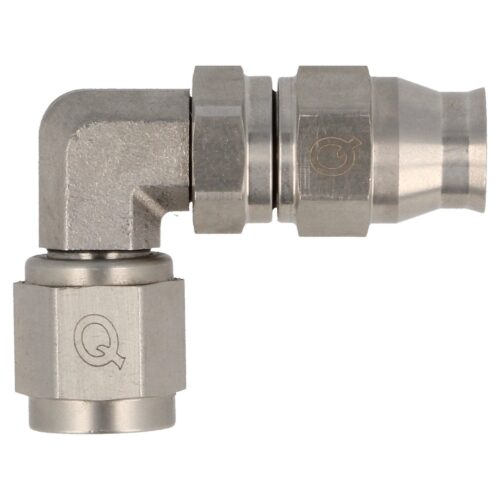


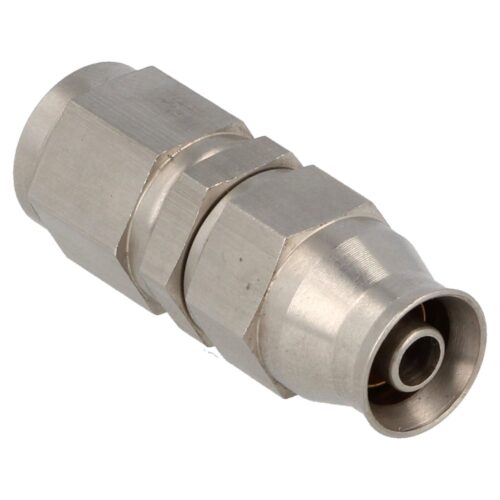


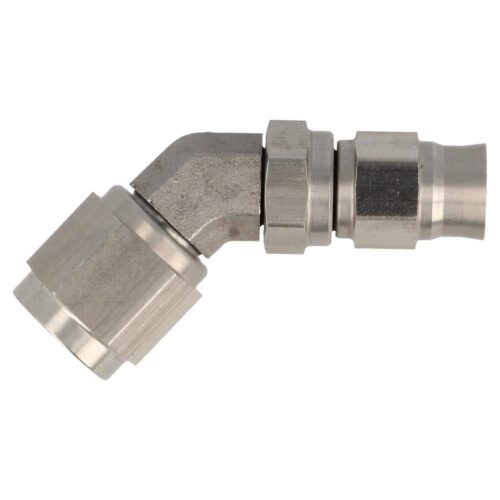


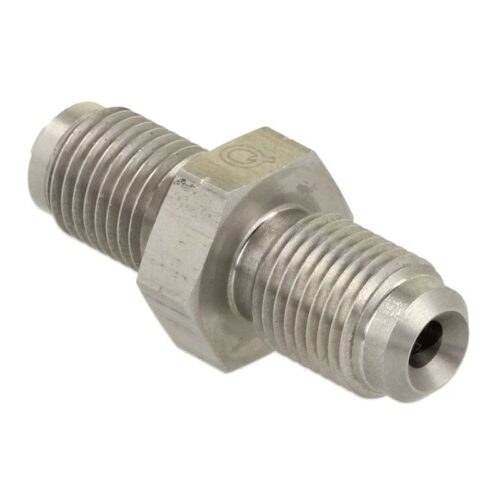


Brake Nipples & Fittings guide
Brake nipples and fittings join the pipes, hoses and components of a hydraulic brake system, and let it be bled. The range covers tube nuts, adapters, connectors, banjo bolts and eyes, bleed fittings, AN fittings and dry-break quick connects.
A brake joint seals at its seat, not on the thread. Brake nipples and glands are tube nuts, male or female, that press a pipe’s flared end into a matching seat. An AN fitting seals on a 37° cone instead. The thread only clamps the joint, so thread, flare and seat must all match.
Pipe ends carry a bubble flare or a double flare, which need different seats. Female connectors are listed as convex or concave, and the seat must suit the flare. Banjo joints seal with a crush washer either side of the eye, while NPT is a tapered thread that seals on the thread itself.
Match these points:
- Thread: metric M10 × 1, M10 × 1.25 and M12 × 1, and imperial 3/8 UNF and 7/16 UNF. M10 × 1 and 3/8-24 UNF are close enough to start by hand, yet the wrong one strips or never seats, so check with a thread gauge.
- AN size: AN3 uses a 3/8-24 UNF thread and AN4 a 7/16-20 UNF, sized for braided hose. Fittings come straight, at 45° or 90°, female to female, and as reducers from AN4 to AN3.
- Adapters and connectors: adapters change the thread between pipe and port, such as M10 × 1.25 female to M12 × 1 male. Connectors join two pipes, some reducing.
- Banjos and bleeding: banjo eyes come straight or at 20° and are listed by bore, such as 10.2 mm; banjo bolts by thread and length. Bleed fittings run from M6 × 1 to M12 × 1.
- Material: steel, brass or stainless steel, in silver or gold; stainless copes well with road salt.
- Quick connects: straight or angled dry-break couplings separate a line with little fluid lost or air let in.
Start every fitting by hand. Use a flare-nut spanner on tube nuts so the flats do not round, and tighten to a firm seat rather than the limit, as excess torque splits flares. Bleed screws seal on a fine cone and need only modest torque, especially in aluminium calipers.
Fit new crush washers to every banjo, and use a brake-fluid-resistant liquid sealant on NPT threads rather than tape, which can shred into the system. After any change, bleed the circuit, hold firm pedal pressure for a minute and check each joint for weeping.

Store Information
TrackTool Factory
Sluispolderweg 7A
1505 HJ Zaandam
The Netherlands
Chamber of Commerce (KVK): 97296902
VAT: NL867990375B01