
Engine Management
Modules & Expanders
- 133 products
- 2 brands
- Ships from EU stock
- Modules & Expanders guide
Top brands in Modules & Expanders


Showing 1–48 of 133 resultsSorted by latest



Modules & Expanders guide
Modules and expanders add functions that an ECU cannot provide on its own. This section holds high-power igniters, CAN-based expanders, wideband lambda controllers and gauges, boost control parts, electronic throttle bodies and switch panels, with the sensors, cables and spares they use.
An ECU has a fixed number of inputs and outputs, and each output can only switch a limited current. When a build needs more sensors, coils or actuators than that, a module carries the load or adds channels. Expanders that talk over CAN add channels without running every signal wire back to the ECU.
A wideband lambda sensor reads the air/fuel ratio across the whole working range, where a narrowband one only switches between rich and lean. Its controller heats and regulates the sensor and turns its signal into a reading for a gauge, logger or ECU.
Choose by the job the module has to do:
- Igniters: four- and eight-channel high-power units, as a kit with a 2 m flying-lead loom or as the loom alone. They drive coils that have no igniter of their own.
- Expanders: CAN-based boxes with 12 or 16 channels. The 12-channel box comes in A and B versions, so two can share one network.
- Lambda: single- and dual-channel meters, needle and digital gauge kits, sensors and sensor cables, and conversion kits with 3, 8 or 18 ft leads. Two channels let each bank of a V engine be read separately.
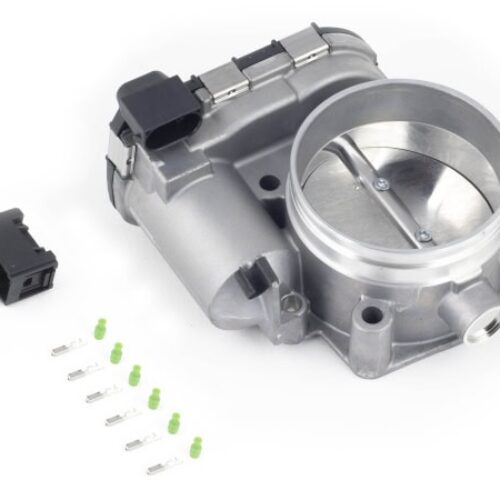
- Boost and throttle: a high-resolution boost solenoid, a CO2 dual-solenoid kit with pressure sensor and an electronic wastegate. Electronic throttle bodies come in 60 and 74 mm, with a pedal connector kit.
- Gauges and sensors: vacuum and boost gauges with 20 or 30 psi scales, and a combined oil temperature and pressure gauge. Plug-in 10 bar pressure and 4 bar MAP sensors connect to a sensor interface.
- Switch panels: dual and triple panels with coloured knobs, for selecting functions from the driver’s seat.
Igniters shed heat through their base, so mount them on clean metal, with thermal paste under factory-style units, and keep them clear of the exhaust. Fit a wideband sensor ahead of any catalyst, tip pointing down and at least ten degrees from horizontal, so condensation cannot collect on it. Never run the engine with the sensor fitted but unpowered, because soot fouls a cold element.
Give each module a fused, switched supply and a clean ground, and complete any software set-up before the first start. Replace a wideband sensor once its readings drift or it responds slowly.

Store Information
TrackTool Factory
Sluispolderweg 7A
1505 HJ Zaandam
The Netherlands
KvK 97296902
BTW NL867990375B01
