

Top brands in X-Pipe Connectors


Showing all 8 resultsSorted by latest
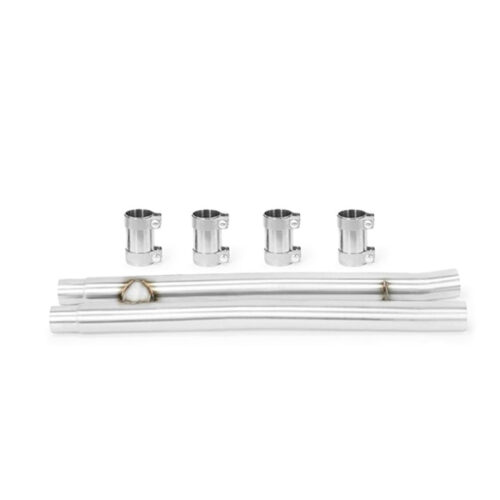


X-Pipe Connectors guide
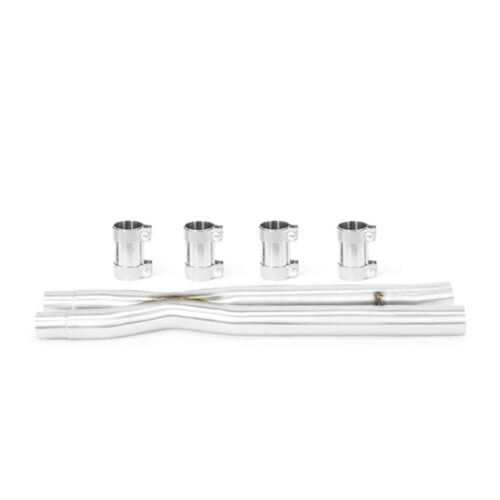
An X-pipe links the two pipes of a dual exhaust where they cross, so gas from each side can pass into the other. Fitted to V engines with a pipe per bank, it changes the sound and evens out the pressure between the banks. Universal X-pieces and connectors are listed here, together with X- and H-pipe crossovers made for a specific model.
On many V engines, each bank fires at uneven intervals, so each pipe carries an irregular train of pulses. A crossover lets those pulses spill into the other pipe and fill the gaps. In an X-pipe the two flows merge briefly at a shallow angle and separate again, which usually gives a smoother, higher-pitched note.
An H-pipe joins the pipes with a short balance tube instead, keeping more of the deep, uneven beat. Both types let the pressure peaks in one pipe spread into the other; any effect on power depends on the rest of the system.
Choose by pipe size and type:
- Universal X-pieces: stainless steel, listed by size A, for 50.8 mm or 76 mm pipe.
- X-connectors: listed by pipe size: 50, 55, 60 and 70 mm.
- Model-specific crossovers: X- and H-pipes made for the car and engine named in the title. Check the listing for road approval; without it, a crossover is for competition use where the rules allow.
- X or H: choose an X-pipe for a smoother, higher note, or an H-pipe to keep a deeper tone.
Place the crossover where the two pipes run close together, after the downpipes and ahead of the silencers. If the car has a lambda sensor in each pipe, keep the crossover behind them, so that each sensor still reads only its own bank.
Keep both sides as symmetrical as the space allows. Tack all four legs first, check that both pipes still line up with their hangers, then weld in short alternating runs to limit distortion. Leave room around the gearbox crossmember and propshaft, and hang the system on both sides of the crossover so the welds carry no weight.

Store Information
TrackTool Factory
Sluispolderweg 7A
1505 HJ Zaandam
The Netherlands
KvK 97296902
BTW NL867990375B01
