
Top brands in Fuel Lines


Showing all 34 resultsSorted by latest


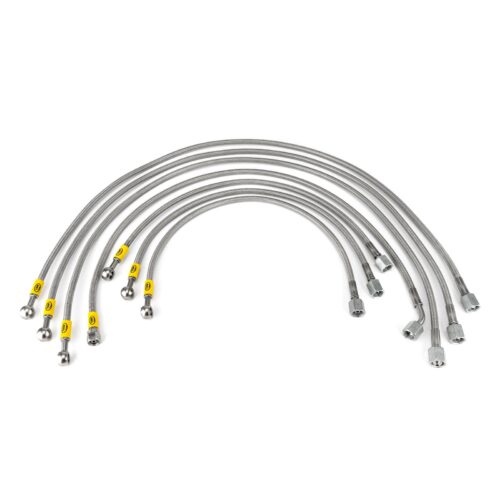
Porsche 911 SC Braided Injector Lines (7x) – POR-7-205-INJ

High-Flow Fuel Rail (B-Series / Universal)

Tucked Fuel Line Kit (02-06 Acura RSX & 06-11 Civic Si & 01-05 Civic Si)

B-Series Fuel Line Kit (92-00 Civic & 94-01 Integra)

Hybrid Racing- Push-on Fuel Fitting (01-05 Honda Civic Si & 02-06 Acura RSX)

Hybrid Racing- Push-on Fuel Fitting (06-11 Honda Civic Si)

Hybrid Racing- Push-on Fuel Fitting (06-11 Honda Civic Si)

Hybrid Racing- K-Series Swap Standard Fuel Line Kit (92-00 Civic & 94-01 Integra)
Fuel Lines guide
Fuel lines carry fuel from the tank to the engine and back, and form the tank’s vent and filler connections. The range runs from stainless and aramid-braided hose to rubber and filler hose, universal fuel rails, adapters from factory line sizes to AN, carburettor supply lines and line kits.
Line size is about pressure drop. Friction loss climbs steeply with flow speed, so a small bore, a long run or tight bends all cost pressure. A pump with spare capacity can cover some loss on the pressure side, but on the suction side, restriction lowers the pressure until warm fuel turns to vapour. A return-style system also needs a return line, often a size smaller than the feed.
Heat pushes fuel towards vapour too. A feed near the exhaust or turbo warms the fuel, and the return carries engine-bay heat to the tank. Routing lines along the cool side and shielding them near hot parts keeps the fuel liquid and its temperature stable.
Compare bores in millimetres:
- Stainless-braided hose: AN4 (5.5 mm) to AN20 (28.5 mm), with a nylon-reinforced CPE core. For high-ethanol blends, check the rating or use PTFE line.
- Aramid-braided hose: AN4 (7.0 mm), AN8 (13.3 mm) and AN10 (16.5 mm). Its listed bores are wider than the stainless hose’s at the same dash size, and it is lighter and gentler on nearby parts.
- Rubber and filler hose: 8 mm NBR hose with a CPE lining for clamped push-on joints, and 50 or 57 mm filler hose, clear or black, some of it polyester-polyurethane.
- Rails and adapters: universal rails in 12, 14 and 18 mm, black or blue, and adapters from 7.94 or 9.52 mm line to AN6 or AN8 male. More rail volume damps injector pulses.
- Kits: single and double carburettor supply lines with AN6 ends, braided injector line sets, and line kits listed by model or engine swap.
Keep each line in as few pieces as possible, support it with cushioned clips at regular intervals, and use flexible hose wherever it crosses from body to engine. Inside the cabin, follow your series’ rules on line material and joints, and clamp large filler hose so it cannot kink or pull off.
Pressure test with the pump running before the engine starts. Replace hose with a cracked or swollen cover, broken braid or weeping ends, and trace any fuel smell in the cabin at once.

Store Information
TrackTool Factory
Sluispolderweg 7A
1505 HJ Zaandam
The Netherlands
KvK 97296902
BTW NL867990375B01
