
Electrical
Switches and Push Buttons
- 69 products
- 3 brands
- Ships from EU stock
- Switches and Push Buttons guide
Top brands in Switches and Push Buttons



Showing 1–48 of 69 resultsSorted by latest




Switches and Push Buttons guide
Switches and push buttons put the car’s circuits under the driver’s hand: ignition, starter, fuel pump, fans, lights and the master cut-off. In a competition car they are grouped where a belted-in driver can reach them, clearly marked and guarded against knocks. The choice includes toggle, rocker and push-button switches, start panels, kill switches, battery isolators and high-current circuit breakers.
A switch is rated by the current its contacts can break, and breaking direct current is harder than alternating current because the arc never meets a zero crossing. Treat the 12 V 20 A rating on the LED rocker and toggle switches as a ceiling, and run motors, pumps and fans through a relay.
Most competition rules ask for a master switch that cuts every live circuit and stops the engine too. A running alternator can keep the ignition alive after the battery is disconnected, so check that the switch has contacts for the ignition circuit.
Decide what each switch must do, then pick the type.
- Toggle functions: on–off, on–off–on, and momentary-on positions on one or both sides. Momentary contacts suit a starter or anything held down; latching ones suit circuits that stay on.
- Sealing: waterproof toggles and water-resistant push buttons for open cars, rally cars and low-mounted panels.
- Illumination: LED switches in green, blue, orange, red and yellow show which circuits are live. The LED usually needs its own earth wire.
- Starting: starter buttons, some with an LED, start panels, including a carbon one, and kill switches under red, transparent blue or carbon-look covers.
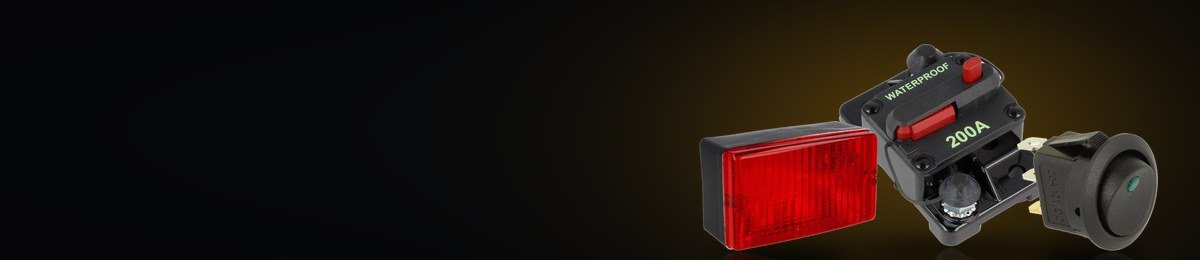
- Isolation and protection: master disconnect and heavy-duty battery switches, emergency cut-off switches, and circuit breakers with ratings such as 60, 135 and 200 A. A manual-reset breaker stays open until reset, while an automatic one recloses after cooling and cycles on a lasting fault.
- Brake light switch: a hydraulic pressure switch with a 1/8 NPT thread, for pedal boxes without a pedal switch.
Place the panel where it can be reached with the belts tight, and label every switch, since a driver under pressure reaches by position rather than by reading. Use insulated crimp terminals on the switch tags, leave enough slack for the panel to come out, and support the loom so the tags carry no weight. Seal the tapered thread of a pressure switch with a compound suited to brake fluid rather than tape, then bleed the brakes.

Store Information
TrackTool Factory
Sluispolderweg 7A
1505 HJ Zaandam
The Netherlands
KvK 97296902
BTW NL867990375B01
