Top brands in Battery Accessories



Showing all 38 resultsSorted by latest


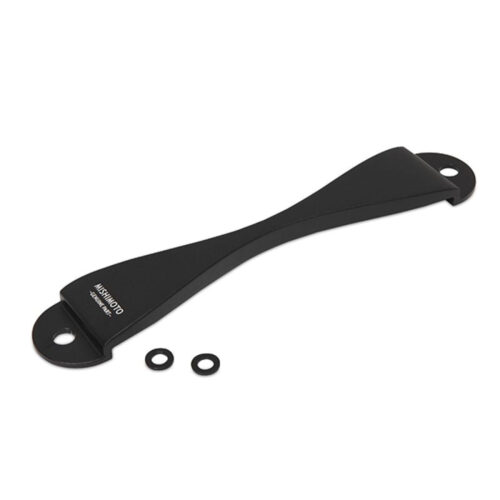
Subaru Universal CNC Battery Tie-Down Black – MMTD-SUB-BK
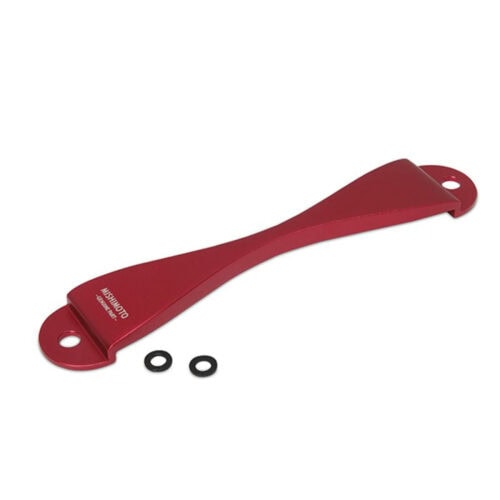
Subaru Universal CNC Battery Tie-Down Red – MMTD-SUB-RD

Hybrid Racing- Battery Relocation Bracket (06-11 Civic Si)
Battery Accessories guide
Battery accessories cover the heavy end of the electrical system: main cables, terminals, isolators, mounts and boxes. A battery moved to save weight or improve balance needs all of them, sized for the hundreds of amps a starter motor draws. Battery cable, terminals and covers, isolation switches, feedthroughs, distribution points, battery supports and tie-downs all sit here.
Cranking draws a very high current for a few seconds, so even a small resistance in a cable or joint costs starting speed and heats the connection. A relocated battery can add several metres of cable, and the earth return through the body must be as good as the positive feed. The main positive cable usually has no fuse, so a chafed run can short straight to the body.
Size everything to the cable.
- Cable: red and black battery cable in 10, 16, 25, 35 and 50 mm², supplied by the metre. Longer runs and larger engines call for the bigger sizes.
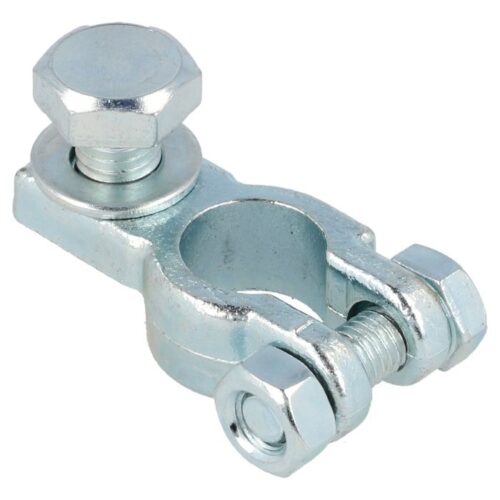
- Terminals: clamp terminals with M8, M10 or M12 threads, in wing-nut and snap-closure types and in positive and earth versions. The two tapered battery posts differ in diameter, so the clamps are not interchangeable.
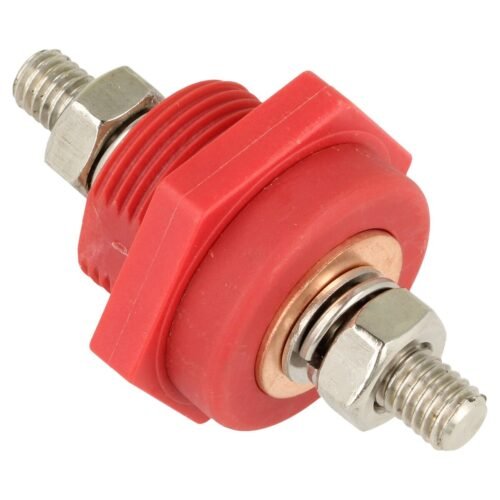
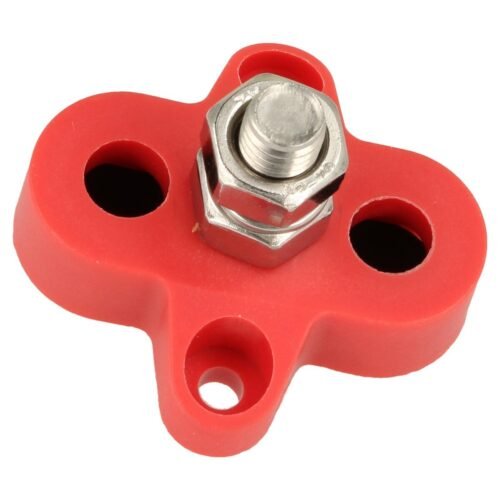
- Distribution: an M10 feedthrough carries the main feed through a bulkhead on a stud, and an M8 distribution point gives branch circuits a solid connection.
- Isolation: isolation switches, including dual-battery versions, and a dual-battery selector switch rated for 6 to 32 V.
- Mounting: a polypropylene battery box, aluminium supports sized for particular compact batteries named in the title, CNC-machined tie-downs and a relocation bracket.
- Covers: insulating terminal covers in red and black.
Disconnect the earth lead first and reconnect it last, so a spanner touching the body cannot short the positive terminal. Crimp lugs with a tool made for the cable size, seal them with adhesive-lined heat-shrink and cover every positive connection. Run the main cable inside the car where possible, clipped at short intervals, and add an earth strap between engine and body.
A wet battery inside the cabin gives off hydrogen while charging, so its box must vent outside the car. Clamp the battery so it cannot move under braking or in an impact, and keep the terminals clean and tight, with a light coat of grease against corrosion.

Store Information
TrackTool Factory
Sluispolderweg 7A
1505 HJ Zaandam
The Netherlands
Chamber of Commerce (KVK): 97296902
VAT: NL867990375B01