
Top brands in Tachometers

Showing all 5 resultsSorted by latest


Tachometers guide
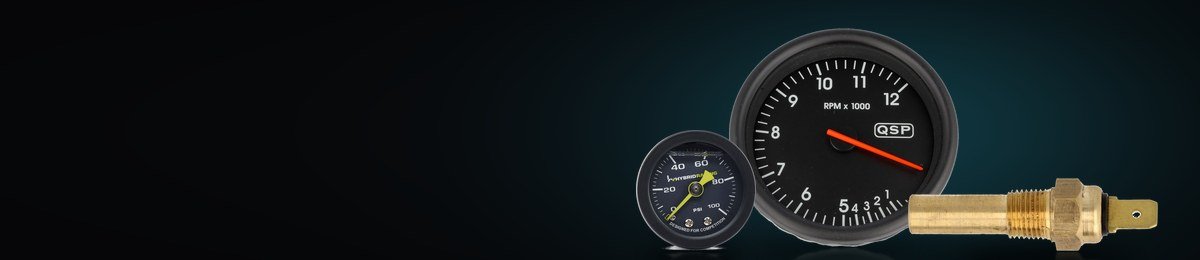
A tachometer shows engine speed, so the driver can shift at the right point and keep clear of the rev limit. This section holds rev counters with 0–8000 and 0–12000 rpm scales, as plain gauges, with a recall memory, or with both rev and recall functions.
An electronic tachometer counts ignition pulses and converts them to engine speed. A four-stroke engine fires each cylinder once every two revolutions, so the gauge has to be set for the number of cylinders. The signal comes from the coil negative on older systems, or from a tach output on an ECU or igniter.
Recall stores the highest engine speed reached. After a session it shows whether a missed shift took the engine past its limit, which a busy driver may not notice at the time.
Choose the scale and functions:
- Scale: 0–8000 rpm suits most road-based engines, while 0–12000 rpm suits high-revving units. The shift point should sit well up the dial, not crowded at the end of the sweep.
- Functions: plain, recall, or rev and recall, as named in the title. Recall is the function for checking over-revs after a run.
- Size: listed at 100 × 100 mm, with a height of 55 or 65 mm by version, so measure the panel and the space behind it.
Take the signal from the source the gauge’s instructions name, and use twisted or shielded cable if the needle flickers. Mount the gauge in the driver’s direct line of sight; many racers turn it so the shift point sits at twelve o’clock. Check its reading against the ECU after fitting, and clear the recall before each session.

Store Information
TrackTool Factory
Sluispolderweg 7A
1505 HJ Zaandam
The Netherlands
KvK 97296902
BTW NL867990375B01
