Top brands in Bucket Seats




US-Racing Seat Frame Right (Universal)

US-Racing Seat Frame Left (Universal)

Steel adapter for PP ABE/PP Carbon ABE

Pole Position N.G. – Velour red

Pole Position ABE-Art leath black/bl.

Profi SPG – Velour black

Pole Position ABE – Velour black
Bucket Seats guide
A bucket seat holds the hips, ribs and shoulders in a fixed shell, so the body moves with the car instead of sliding about within the seat. The range holds FIA-labelled and German road-approved seats in velour or artificial leather, a non-FIA fibreglass seat with mesh upholstery, universal left and right seat frames and a steel adapter.
A fixed back has no recline mechanism, which in a road seat is a weak point in a crash. Side bolsters at the hips and shoulders take the cornering load, so the driver no longer braces with arms and legs, leaving them free for steering and pedals. Harness straps pass through slots in the shell, and the shoulder slots should sit level with, or just above, the shoulders.
To choose, consider:
- Homologation: an FIA seat’s label shows its date of manufacture, and the homologation runs for a set number of years from it. The non-FIA seat is made for sim rigs, show cars and track-day builds where no label is required.
- Road approval: versions marked ABE carry a German general operating permit, which allows road use when fitted as the permit specifies. A steel adapter is listed for these shells.
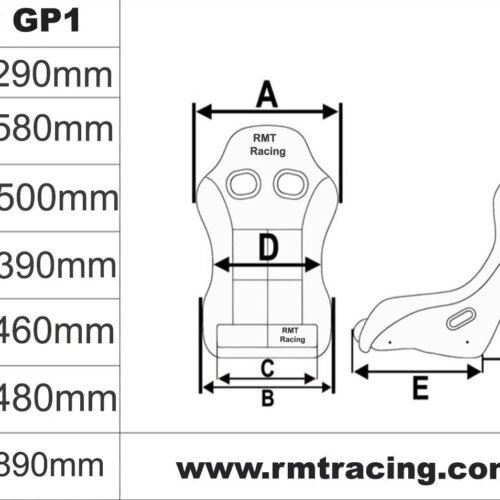
- Size: where listed, seat width, depth and height are given with a tolerance of ±10 mm. The shell should hold the hips without pinching and leave the shoulders free to turn the wheel.
- Trim: velour breathes and holds the driver in place, artificial leather wipes clean, and mesh lets air through on a hot day.
- Frames: the universal frames span 43 cm across the car and 37.5 cm along it between mounting points, with sides defined for European-market cars.
Sit in the seat in your race kit and helmet before drilling anything. Check the head room to the roof or cage, your reach to wheel and pedals, and how the harness slots line up. Never cut or drill an FIA shell, as that ends its homologation. Inspect the shell for cracks after an off, and replace it after a heavy impact.
Recently Viewed Products
EFA173 – EBC Brake Pad Sensor Wire; Front


Store Information
TrackTool Factory
Sluispolderweg 7A
1505 HJ Zaandam
The Netherlands
Chamber of Commerce (KVK): 97296902
VAT: NL867990375B01