
Fits your Civic MB · 1995–2001
Catalytic Converters for Honda Civic MB
- 8 parts fit
- Ships from EU stock
- Catalytic Converters guide
- All 99 in Catalytic Converters
Showing all 8 resultsSorted by latest


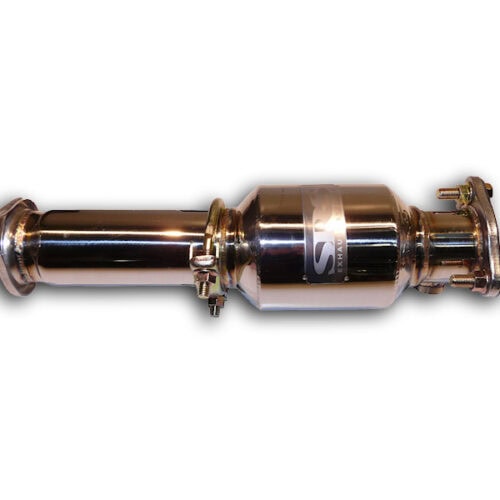


Adjustable Catalytic Converter/Testpipe (Civic/CRX 87-01/Del Sol/Integra 94-01/CR-V)

Catalytic Converters guide
A catalytic converter cleans the exhaust gas by passing it through a coated honeycomb, where carbon monoxide, unburnt fuel and nitrogen oxides are turned into less harmful gases. This section holds universal and sport converters, bare metallic substrates and vehicle-specific units, listed by size, cell density and emissions level.
The honeycomb, or substrate, carries a thin coating of precious metals. It works once hot, and it treats all three pollutants only when the mixture stays close to the ideal air-fuel ratio. Cell density, in cells per square inch (cpsi), sets the trade-off: more cells give more surface for conversion, but a more restrictive path for the gas. Metallic substrates have thinner walls than ceramic ones, so they flow more freely at the same density and cope better with vibration and thermal shock.
Converters usually fail because of the engine. Misfires or a rich mixture send unburnt fuel into the substrate, where it burns and can melt the honeycomb, while burning oil or coolant poisons the coating.
Use the listing details to choose:
- Cell density: 400 cpsi for the ceramic units, and 100 or 200 cpsi for the metallic and race units.
- Emissions level: titles state Euro 3, 4, 5 or 6. For road use, match the car’s own emissions standard and check which replacements local rules accept.
- Size: sport units connect at 50 to 90 mm. Universal units list the body diameter (102 to 130 mm), inlet (57 or 63 mm) and length (185 to 500 mm). A bigger body lowers restriction and adds conversion capacity, but takes longer to warm up.
- Layout: centre or offset connections, some with a lambda sensor boss.
- Bare substrates: metallic cores 90 to 130 mm across and 100 mm long, at 200 cpsi, for building into your own housing.
- Vehicle-specific units: direct-fit converters and adjustable-length race converters in polished SUS 304 stainless, supplied with gaskets and fixings; the adjustable type spans 32 to 48 cm.
Fit a converter with new gaskets, and follow any flow-direction arrow on the case. A position closer to the engine warms up sooner but runs hotter, so keep to the original layout where there is one. On cars with a sensor behind the converter, a lower-density unit can set a catalyst-efficiency fault.
A rattle from inside the case means the substrate has broken up, so replace the unit before loose pieces block the exhaust. Race converters are for competition use where the rules allow; on a road car they can affect type approval, inspection and insurance.

Store Information
TrackTool Factory
Sluispolderweg 7A
1505 HJ Zaandam
The Netherlands
KvK 97296902
BTW NL867990375B01
