
Fits your CRX ED · 1987–1992
Engine Bearings for Honda CRX ED
- 6 parts fit
- 2 brands
- Ships from EU stock
- Engine Bearings guide
- All 274 in Engine Bearings


Showing all 6 resultsSorted by latest

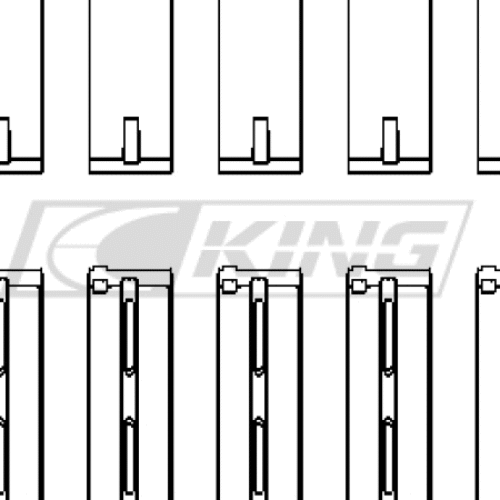
King Main Bearing Shell HONDA A-SERIES, B-SERIES, K-SERIES


Engine Bearings guide
Engine bearings are the thin shells the crankshaft runs in: main bearings in the block, conrod bearings in each big end, and thrust bearings that locate the crank lengthways. All three types are here, and some shells carry a polymer coating.
A healthy plain bearing does not run metal on metal once the engine is turning. The journal drags oil into the narrowing gap and builds a pressurised wedge, so the load rides on a film only microns thick at its thinnest. The pump only has to keep that gap full. Clearance decides how well the film holds: too tight and it runs hot and thin, too loose and pressure falls while the load bears on a narrower strip of shell.
Each shell is a steel back carrying softer bearing layers. The halves stand slightly proud of the housing’s parting line, so tightening the cap crushes them into the bore. That crush stops them turning and carries heat away; the tab only positions them. Softer layers can embed small debris, while harder race materials carry more load but forgive dirt and misalignment less.
Shells are listed by engine and position, with the measurements to check against your parts:
- Position: conrod, main or thrust bearing. The thrust bearing sets the crankshaft’s end float and takes the push of the clutch release.
- Version: Std. in a title marks the standard shell. The X version (X-Vers.) usually denotes extra oil clearance, which some builders choose for high loads or a thicker oil; check the listing to be sure.
- Coating: polymer-coated shells carry a layer that protects the surface when the film is thin, as at start-up or under peak load.
- Dimensions: journal (shaft) diameter, for example 49.959–49.975 mm, housing bore and shell width, such as 16.90 or 17.90 mm. Titles also flag variants without a locating notch or with a particular width.
Measure rather than assume. Check each journal with a micrometer and each bore with a bore gauge, shells fitted and caps torqued, to find the clearance. A plastic gauge strip makes a useful cross-check. A reground crankshaft needs undersize shells to match the grind.
Fit the shells with clean, dry backs, oil only the running faces with assembly lube, and prime the oil system before the first start. On a track car, oil surge in long corners starves the bearings first, so the sump and the oil level matter as much as the shells.
Recently Viewed Products

CCRK1-031 – Girodisc Caliper Rebuild Kit; Front

GD7364 – EBC GD Dimpled & Slotted Brake Discs; Front

Store Information
TrackTool Factory
Sluispolderweg 7A
1505 HJ Zaandam
The Netherlands
KvK 97296902
BTW NL867990375B01
