
Mid Braces
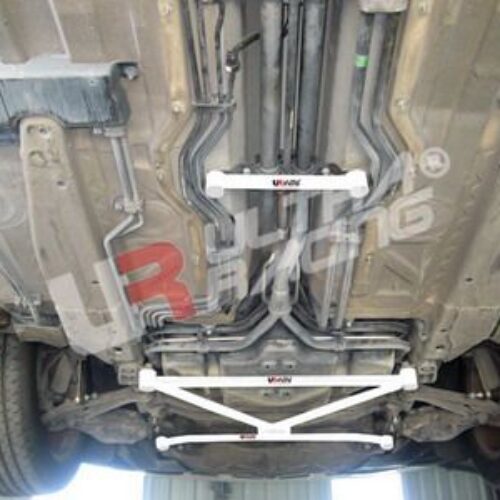
Mid braces bolt under the middle of the car, across the floor pan and transmission tunnel between the front and rear axles. They stiffen the part of the shell that carries twist between the axles, and range from single bars to paired side and floor bars and H-shaped braces.
A monocoque resists twisting through the whole shell, and the sills, floor and tunnel carry much of that load. The tunnel is an open channel, and through corners and over uneven surfaces its two sides can flex apart and back. A brace bolted across it closes that open section, so the floor behaves more like a closed box. Convertibles depend on the floor more than most, because they have no roof to carry part of the load.
A shell that twists acts like an extra soft spring between the front and rear suspension. The balance set by springs and anti-roll bars then blurs as the load changes, and the car can feel vague mid-corner. A stiffer middle section lets those settings work as they were chosen.
Compare the titles on four points:
- Layout: a mid lower brace crosses the tunnel, while side or floor bars come in pairs along each side of the floor. An H-shaped brace combines a cross member and two side members in one piece.
- Point count: 2-, 4- and 6-point braces are listed, plus paired bars with two to four points each. Every added point gives the load another path into the shell.
- Vehicle detail: two- and four-wheel-drive versions of one model can need different braces, so the drive layout matters here. Read the chassis code and engine in the title as well.
- Clearance: the brace sits beneath the exhaust and, on rear- and four-wheel-drive cars, the propshaft. Check the gap to both, and to the road on a lowered car.
Mid braces usually pick up existing studs or threaded holes in the floor. Start every bolt by hand, as a cross-threaded captive nut in the floor is awkward to repair, then tighten it to the specified torque. Check afterwards that the exhaust can still move freely on its hangers.
A mid brace complements front and rear lower braces rather than replacing them, because the shell is only as stiff as its weakest section. Road salt collects underneath, so clean and inspect the brace and its fixings at each service.
Showing the single result


Store Information
TrackTool Factory
Sluispolderweg 7A
1505 HJ Zaandam
The Netherlands
KvK 97296902
BTW NL867990375B01
