
Brake Lines
Brake lines carry the fluid pressure to each caliper. The flexible hoses at each wheel are rubber on most cars. Replacing them with braided stainless steel hoses gives a hose that swells less under pressure and is better protected against stones and road debris.
Most lines here are braided hose sets made for a specific model and supplied for all four corners, and many are listed with TÜV approval. For making or repairing the rigid pipes along the body, there is also copper-nickel (Cunifer) and copper brake pipe in coils, listed by outside diameter. You cut, flare and fit it with the correct unions.
Check that a hose set matches your car’s calipers, including any aftermarket caliper, as hose length and end fittings can differ between versions of the same model.
Fitting lines means opening the hydraulic system, so plan a full bleed afterwards and consider changing to fresh, high-boiling fluid at the same time. Use new copper washers on banjo fittings. Route each hose so it cannot touch the tyre or suspension at full lock or full droop, and clip it into the original brackets. For rigid pipe, use a proper flaring tool and the flare shape your car uses, and pressure-check every joint before driving.
Showing the single result
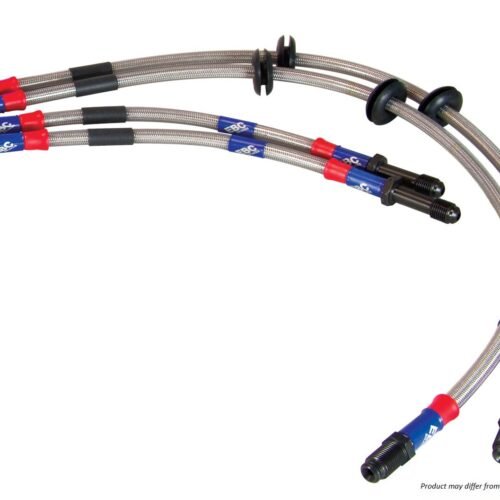
BLA1207-4L – EBC Braided Steel Brake Lines; Front & Rear


Store Information
TrackTool Factory
Sluispolderweg 7A
1505 HJ Zaandam
The Netherlands
KvK 97296902
BTW NL867990375B01
