

Engine power gets the headlines, but brakes win lap times — and keep you out of the gravel. Choosing the right brake pad for track use is one of the highest-impact, lowest-cost upgrades you can make to any performance car. Pick the wrong compound and you risk brake fade, glazed pads, cracked rotors, ruined fluid, and — in the worst case — a serious incident at the end of the longest straight on the circuit.
This guide explains why track brake pads behave so differently from street pads, how to read a compound's operating temperature window, what really separates trackday, sprint and endurance pads, and how the major motorsport brands — Pagid, Ferodo, Hawk and EBC — fit into the picture. By the end you will know exactly which pad family to look at for your car, your driving style, and the events you actually attend.
Why Track Brake Pads Are Fundamentally Different From Street Pads
On the street, a brake pad spends 99% of its life cold. It needs to bite from the first stop, be quiet, kind to wheels, and last tens of thousands of kilometres. On track, the priorities invert almost completely. A single hard lap can take pad and rotor temperatures from ambient to over 600 °C in under a minute, hold them there for twenty laps, and drop them again on cool-down. The friction material has to survive that thermal cycle without losing bite, without destroying the disc, and without contaminating the brake fluid behind the caliper.
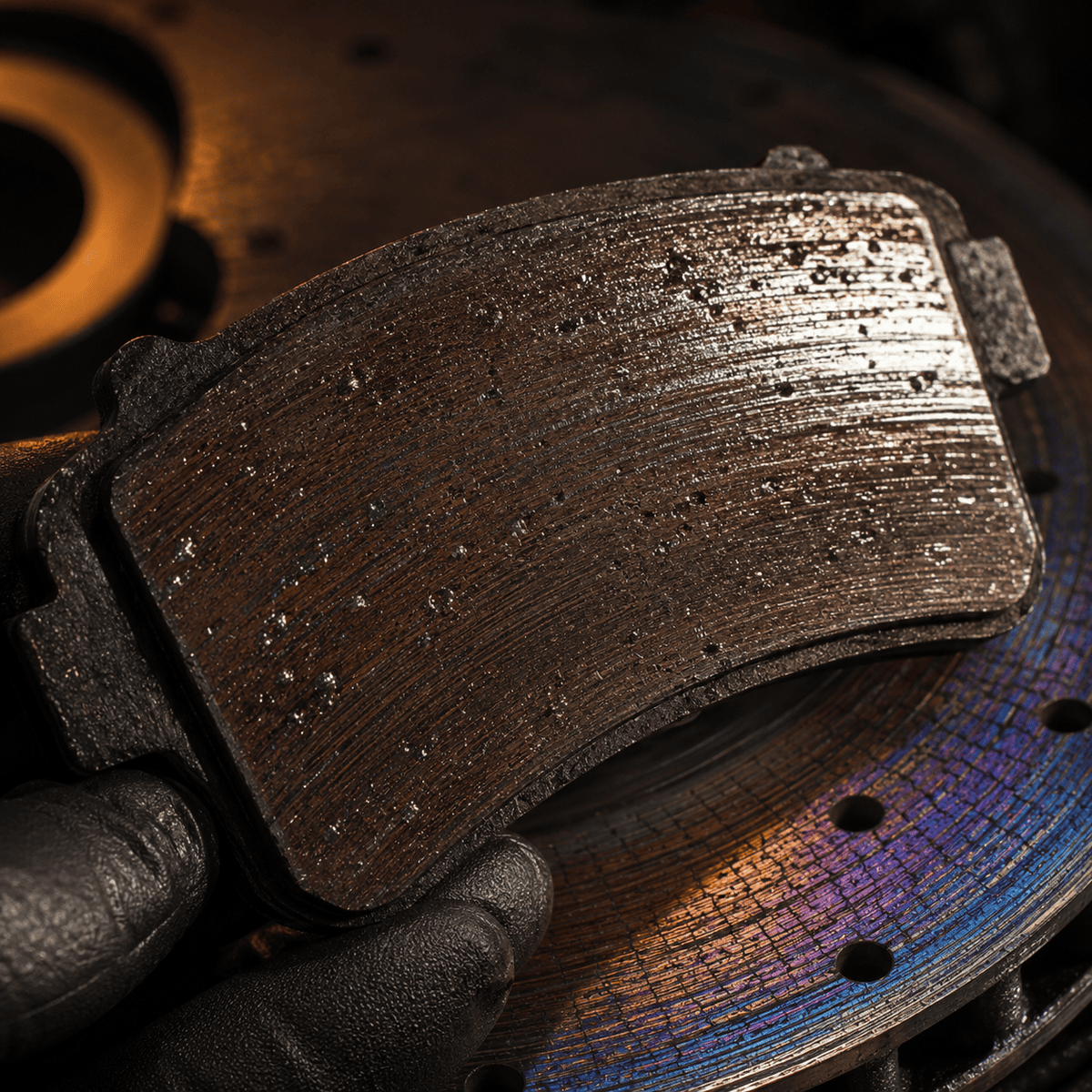
A street pad asked to do this job will fade — the binders in the friction material decompose, gases form a low-friction film between pad and rotor, the pedal sinks, and stopping distances grow alarmingly. Worse still, the same pad will frequently glaze: a hard, glossy layer forms on the friction surface that refuses to grip the disc even when temperatures return to normal. At that point the pads are usually finished, and the rotor surface often is too.
Track brake pads use entirely different binder chemistries, abrasive packages, and fibre reinforcements — typically aramid, copper, steel and ceramic compounds — to deliver a stable coefficient of friction across a much wider and higher temperature window. That is the entire point of a "race" pad: not necessarily more bite, but consistent bite, lap after lap.
The Science Behind Brake Pad Performance
Operating Temperature Window
Every friction compound has a manufacturer-published operating temperature range. Below the minimum, the binders have not reached their working state and the pad feels wooden, inconsistent, sometimes even slippery. Above the maximum, the binders break down, gas off, and the friction coefficient collapses. This is what brake fade physically is.
The published minimum matters as much as the maximum. A pure endurance compound that runs from 200 °C to 800 °C will be downright dangerous on the road or on out-laps because it cannot generate enough friction when cold. This is why "more aggressive" does not mean "better" — it means "narrower window pushed higher".
Coefficient of Friction (μ)
The coefficient of friction is the ratio of friction force to clamping force. A typical OE pad sits around μ = 0.35. Fast-road and trackday compounds run μ = 0.45 to 0.55. Full race compounds can exceed μ = 0.60. Higher μ means more torque at the rotor for a given pedal effort — but only if the pad is in its temperature window. A high-μ compound below its operating range may produce less stopping power than the OE part it replaced.
Friction Curve Behaviour
Two pads with the same nominal μ can feel completely different. What matters to a driver is the shape of the friction curve across the working range. A flat curve gives a predictable, modulatable pedal that behaves the same on lap 1 and lap 20. A peaky curve with a rising or falling slope means the car feels different every corner as brake temperatures change — and that destroys driver confidence faster than any other single problem in a car's setup.
Wear Rate and Rotor Compatibility
Race compounds are typically harder and more abrasive than street pads, and they transfer a layer of friction material onto the rotor surface. If that transfer is clean and even, pad and rotor wear are stable and predictable. If the pad is mismatched to the rotor or bedded-in poorly, you get uneven transfer, hot spots, judder, and short rotor life. This is why track pads should always be installed on rotors in good condition — slotted or dimpled discs from manufacturers such as DBA, Girodisc or Centric are commonly paired with race pads for exactly this reason.
Brake Pad Categories Explained
It helps to think of track-capable pads as falling into four broad families. The boundaries are not absolute — a "fast road" pad from one brand may be a "trackday" pad from another — but the framework is useful when you are reading product pages.
| Category | Typical Operating Range | Best For | Compromise |
|---|---|---|---|
| Performance street / fast road | 0 – 500 °C | Spirited road use, occasional sighting laps | Will fade in a sustained track session |
| Hybrid street / trackday | 0 – 650 °C | Dual-purpose cars, club trackdays | Noisier on the street, faster rotor wear |
| Trackday / sprint race | 100 – 750 °C | Dedicated track cars, short events | Poor cold bite, not road-legal in feel |
| Endurance race | 200 – 850 °C | Long stints, GT and prototype cars | Higher minimum temp, demands serious cooling |
The Risks of Running the Wrong Pad on Track
Many drivers arrive at their first trackday on factory OE pads and discover the limitations the hard way. The failure modes are well-documented and predictable:
- Brake fade. The most obvious symptom — pedal travel grows, stopping distances extend, and the car carries unexpected speed into corners. Usually caused by the pad binders exceeding their thermal limit.
- Pad glazing. A hard, shiny layer forms on the friction surface after overheating. Even when cool, the pad refuses to bite. Sometimes recoverable with a fresh bed-in cycle; often not.
- Boiling brake fluid. Heat soaks back through the pad and piston into the caliper. Standard DOT 4 fluid begins to boil and the pedal goes to the floor. This is why a high-temperature fluid such as the Torque Racing RT700 is part of any serious track brake package.
- Rotor cracking and heat checking. Surface micro-cracks radiating from the vanes, often caused by a pad that is too aggressive for a road-spec rotor, or by parking a fully-heated car without a cool-down lap.
- Pad knockback. Overheated calipers and worn wheel bearings allow the pistons to retract. The first stab of pedal is empty, which is unsettling at 200 km/h on the approach to a hairpin.
None of these failures are mysterious. They are the natural consequence of asking the wrong compound to do a job it was never designed for.

Comparing the Leading Track Brake Pad Brands
The brake pad market is crowded but a small group of manufacturers dominate the motorsport end of the pad business. Below is a working overview of the brands TrackTool Factory stocks, organised by compound family. Always cross-reference with the manufacturer's data sheet for your specific application — pad shape, backing-plate spec and abutment design vary by car.
Pagid Racing — the full compound matrix
Pagid Racing is the OE pad supplier for huge swathes of GT and endurance racing, including most factory Porsche Cup programmes. Their motorsport line is the broadest we stock — roughly 800 SKUs across seven compound families, each engineered for a specific thermal envelope:
- RSL — sprint and short-run race. The most-shipped Pagid family, with six variants in our catalogue: RSL 1 (roughly 50 – 550 °C, unusually friendly from cold, ideal for lower-energy cars and short sprints), RSL 2 and the newer-revision RSL 2E, RSL 19 (sits between RSL 1 and RSL 29 — a touch more headroom without giving up cold bite), RSL 29 (the staple of GT4 and Porsche Cup programmes, a meaningful step up in thermal capacity over RSL 1) and the recent RSL D1 sprint-endurance refinement.
- RST — hybrid trackday. Five variants: RST 1, RST 2, RST 3, RST 4 and RST 5. RST 3 is the workhorse — a 150 – 750 °C metal-ceramic compound that handles fast road, club trackdays and lightly-modified GT cars without complaint. RST 1 and 2 sit slightly cooler for daily-drivable trackday duty; RST 4 and 5 lift the ceiling again for heavier cars.
- RSC — ceramic-disc only. Engineered specifically for ceramic composite discs (PCCB, CCM) on high-end Porsche, Ferrari and McLaren cars. We stock RSC 1 (100 – 650 °C, the all-round endurance choice) and RSC 2. Critical: do not fit an RSC compound to a cast iron rotor — the friction couple is engineered for ceramic surfaces only and the wrong pairing destroys both pad and disc in one session.
- RSH — heavy car and high-friction. Cast-iron-disc compound family for heavier or higher-energy cars. Four variants we carry: RSH 3, RSH 29, the newer-revision RSH 29E and RSH 42. RSH 42 is the heaviest-duty option and a common rear-axle pairing on saloon-based GT entries.
- RS — top-end race. The original PAGID race family that still anchors much of professional endurance racing. We carry RS 14 (sprint race, roughly 200 – 800 °C), RS 42 and RS 44. The benchmark RS 29 (200 – 900 °C) is the reference compound cited in most professional GT bulletins.
- RSX — newer-gen race. PAGID's most recent racing compound, designed to bridge the gap between RST trackday feel and full RS-family thermal capacity. Niche application list at the moment — talk to us before committing.
- Street+ — for completeness: if you don't actually need a race pad, Pagid's Street+ line is the fast-road answer with a roughly 0 – 400 °C window. Capable on the road but not designed for sustained track heat.
Ferodo Racing — DS2500, DS3.12, DS1.11 and DSUNO
Ferodo Racing sits at the opposite corner of the GT world from Pagid and the rivalry is decades old. The compound range is similarly stratified:
- DS2500 — the iconic fast-road / trackday pad. Effective from approximately 0 – 500 °C with very good cold bite, low noise and modest rotor wear. Probably the most-recommended single pad for first-time trackday drivers in fast road cars.
- DS3.12 — race compound for sprint and middle-distance use. Working range around 300 – 850 °C. Demands proper warm-up but is one of the most torque-consistent pads on the market.
- DS1.11 — broad-range race pad, roughly 200 – 750 °C. Friendlier minimum temperature than DS3.12, popular for shorter races and trackday warriors with capable rotor cooling.
- DSUNO — Ferodo's premium endurance compound, working up to around 750 °C with very stable torque and low wear.
Hawk Performance — HP+, DTC-60 and DTC-70
Hawk Performance dominates much of the North American club racing scene and brings a different compound philosophy:
- HPS / HP+ — performance street and entry-level trackday. HP+ is a well-known dual-use pad and is commonly the first upgrade made on Miata, BRZ/86 and E46 M3 chassis.
- DTC-60 — sprint and trackday race pad, optimum temperature roughly 370 – 590 °C, maximum around 870 °C. Strong initial bite without being grabby.
- DTC-70 — higher torque output at the same rotor temperature as the 60, with an optimum band closer to 425 – 650 °C. Designed for heavier and faster cars; a common rear-axle pairing with DTC-60 fronts on V8-powered race cars.
EBC Brakes — from fast street to RP-X race
EBC Brakes has more compounds across more price points than any of the other brands here. We carry roughly 18 000 EBC SKUs in total, but only the race tier — Bluestuff, Orangestuff, RP-X and RP-1 — is genuinely track-grade:
- Yellowstuff — fast street pad with a fade threshold near 400 °C. Capable of sighting laps and demonstration driving, but it will fade in a sustained trackday session on a powerful car.
- Bluestuff NDX — true dual-purpose pad with a working range of roughly 0 – 625 °C and friction coefficient around 0.45. The best EBC choice for genuine street-and-track use.
- RP-X — the headline current-generation EBC race compound. Friction coefficient 0.55 from 0 – 750 °C with full bite from cold, which is rare among race pads — most need a warm-up lap to come into their working window. EBC positions it for under-servoed cars (R35 GT-R, Porsche GT models) where aggressive initial bite is welcome. Sprint races, hill climbs and trackdays on track-prepped cars.
- RP-1 — the other side of EBC's race coin. Friction coefficient 0.45 from 100 – 750 °C; needs warm-up to come on song, then delivers progressive modulation rather than aggressive bite. EBC explicitly targets it at over-servoed cars (Mk7 Golf GTI, BMW M cars, Audi RS models) where a softer initial response avoids over-grabbing. Note: not R90-approved for EU road use — a race-only compound.
- Orangestuff — EBC's earlier-generation full-race compound. Still in production and still effective; for many newer platforms RP-X has taken its place at the top of the lineup, but for cars already proven on Orangestuff there is no reason to switch.
- Greenstuff 2000 / 6000 — for completeness: Greenstuff sits below the track threshold (sport-street for the 2000 series, SUV/light-truck sport for the 6000). Mentioned here only because it appears throughout our catalogue and is sometimes confused with a trackday pad. It isn't one.
A note worth repeating: EBC's Redstuff is explicitly not a track pad. It is a low-dust ceramic-based street compound and putting it on a circuit is asking for fade.
How to Choose the Right Track Pad for Your Car
The right pad is not the most aggressive pad you can afford. It is the pad whose working temperature window matches the temperatures your brake system will actually see — which is a function of vehicle weight, power, aero, brake size, rotor cooling, ambient conditions and how hard you actually drive. Work through these questions before you click buy:
- What does the car weigh? A 1,050 kg Lotus Elise on stock-size brakes sees nothing like the energy a 1,700 kg BMW M3 puts through its rotors. Heavier cars need higher-temperature compounds.
- How much power and top-end speed? Braking energy scales with the square of velocity. Doubling top speed quadruples the energy your brakes have to absorb.
- What rotors are fitted, and how big are they? A larger rotor stores and radiates more heat. A car on a Big Brake Kit (BBK) with vented, slotted rotors will sit in a lower steady-state temperature than the same car on OE rotors at the same lap pace.
- Is there brake cooling? Backing plates, ducts, deflector fins on the rotor hat — all of this changes the temperature equation more than people think.
- How long are your sessions? A 20-minute trackday session is a very different thermal load to a 60-minute endurance stint.
- How experienced are you? An intermediate driver in a Cayman generates less peak brake temperature than an instructor in the same car. Honest answers here save money and frustration.
Recommended Setups by Use Case
These are starting-point recommendations only — always validate against your specific car and circuit before committing to a compound:
- Fast road with occasional trackdays — Ferodo DS2500, Pagid RSL 1 (or RSL 19 for a touch more headroom), EBC Bluestuff NDX or Hawk HP+. All bite cold, behave on the road and survive light track use.
- Dedicated trackday car, club-level pace — Pagid RST 3, Ferodo DS1.11, Hawk DTC-60, EBC Orangestuff or EBC RP-X if you value full cold bite from lap one. Higher minimum temperatures, much higher ceiling.
- Sprint race or time attack — Pagid RSL 29 or RS 14, Ferodo DS3.12, EBC RP-1 (or RP-X for more aggressive initial bite), Hawk DTC-60 front with DTC-70 rear on heavier cars.
- Endurance racing or extended stints — Pagid RSC 1 (ceramic discs only), RSL 2 or RSH 29 for cast iron, Ferodo DSUNO. Pair with race-grade fluid, ducted cooling and frequent inspection.
Common Mistakes When Choosing Track Brake Pads
- Buying the most aggressive pad available. Track pads with high minimum operating temperatures feel terrible — and stop poorly — on cold out-laps and on the drive home.
- Upgrading pads without upgrading fluid. The pad sees higher temperatures, the heat soaks back into the caliper, the fluid boils. New pads on old fluid is one of the most common causes of trackday "brake failure".
- Mixing front and rear compounds carelessly. Changing only the fronts to a high-μ race pad shifts brake bias forward and can cause oversteer-on-trail-braking that was not there before. Brake bias is a real tuning variable.
- Skipping the bed-in. An un-bedded pad has not transferred a friction film to the rotor and will glaze almost immediately at trackday energies.
- Re-using glazed pads. If the pad surface has gone glassy, it needs to be deglazed properly or replaced before the next session.
- Ignoring rotor condition. A race pad on a heat-checked rotor finishes the rotor and itself in one session.
Bedding-In Your Track Brake Pads Correctly
Every race-grade pad requires a bed-in cycle before it will perform — and every manufacturer publishes the procedure for its own compound. There is no universal recipe, but the principle is the same: bring pad and rotor up to working temperature in controlled, progressive stops without coming to a full halt. Stopping hard and holding the pedal while stationary is the single most reliable way to imprint pad material onto one spot of the rotor and create permanent judder.
A representative procedure looks like this:
- Six to ten controlled stops from roughly 100 to 30 km/h with moderate pedal pressure.
- Allow brakes to cool by driving without using them for several minutes.
- Six to ten harder stops from 120 to 40 km/h, again without coming to a halt.
- One long cool-down lap or several kilometres of light driving before parking the car.
If your manufacturer's instructions differ — and they will — follow theirs. Pagid, Ferodo and Hawk all publish detailed bed-in procedures for each compound.
Beyond the Pad — Building a Complete Track Brake System
A great pad is only one part of the equation. To get the best from it you need the rest of the brake system to be ready for the energy load:
- High-temperature brake fluid. A genuine racing fluid with a high wet-boiling point such as the Torque Racing RT700 is non-negotiable on track.
- Vented, slotted or dimpled rotors. A track pad lives or dies by the rotor it transfers material to. DBA, Girodisc, Centric and Wilwood all offer rotor and big-brake-kit options to match your pad strategy.
- Brake cooling. Ducts to the rotor face, deflector plates, vented backing plates — anything that pulls heat out of the system extends pad and fluid life.
- Stainless-braided lines. A firmer pedal under load means more precise modulation of the very pad you just paid for.
- Proper installation. Caliper bracket bolts, pad clips, abutment shims and bedding-in are all easy to get wrong. Take your time and follow the manufacturer’s fitting and bed-in instructions to the letter.
Browse the full Brake System category for compatible pads, rotors, fluid, lines and big-brake kits across every brand mentioned in this guide.
Frequently Asked Questions
Can I run race brake pads on the street?
Technically yes, but the experience is poor for most race pads. They have high minimum operating temperatures, generate cold-pedal noise, throw aggressive dust onto wheels and wear rotors quickly when used at street temperatures. EBC RP-X is the unusual race compound with full cold bite, but you still get the noise, dust and wear penalty on every commute. For genuine dual-purpose cars, hybrid pads such as Pagid RST 3, Ferodo DS2500 or EBC Bluestuff NDX are a much better answer than swapping race compounds twice a season.
How often should I change brake pads on a track car?
Inspection is more important than mileage. Check pad thickness after every session and replace before the friction material drops below the manufacturer's minimum (commonly around 3 mm). Heavy or fast cars on aggressive compounds can finish a set in a single weekend; lighter cars on dual-purpose pads can run multiple events.
Do I need to change brake fluid when I fit track pads?
Yes — or at minimum bleed the system with fresh high-temperature fluid before your next event. Higher pad operating temperatures mean more heat conducted back into the caliper and fluid. A racing fluid such as Torque Racing RT700 raises the boiling threshold substantially over OE DOT 4.
Can I mix front and rear pad compounds?
Yes, and many race teams do exactly that to fine-tune brake bias. A more aggressive front pad shifts bias forward; a more aggressive rear pad shifts it back. Mixing compounds is a tuning decision, not a mistake — but it should be deliberate and tested, not accidental.
What temperature is "too hot" for a brake pad?
The honest answer is: whatever the published maximum is for the compound you are running. A street pad past 400 °C is in trouble. A trackday pad at 700 °C may still be inside its window. Thermo paint or pad-edge temperature paint is a cheap and effective way to measure what your brakes are actually seeing.
Are Pagid and Ferodo really the best brake pads for track use?
They are the dominant choices in GT and endurance motorsport for good reason — wide compound ranges, deep OE programmes and decades of development data. That does not make them the only answer. Hawk dominates parts of North American club racing, and EBC's race tier — Bluestuff, Orangestuff, RP-X and RP-1 — is highly competitive at its price point. The "best" pad is the one whose working range matches your car and your event.

Store Information
TrackTool Factory
Sluispolderweg 7A
1505 HJ Zaandam
The Netherlands
KvK 97296902
BTW NL867990375B01
